Developer Strategies for Addressing Input Latency in Web-Based Competitive Racing and Shooting Titles
Logan Schmitt · Sep 23, 2026

Developer Strategies for Addressing Input Latency in Web-Based Competitive Racing and Shooting Titles
Developers working on web-based racing and shooting titles have refined multiple techniques to reduce input lag, since even minor delays can alter outcomes in high-stakes matches where split-second decisions determine rankings. These approaches combine client prediction algorithms with optimized network protocols, allowing games to maintain responsiveness despite variable internet conditions across distributed player bases.
Core Causes of Input Lag in Browser Environments
Input lag in these titles stems from several layers including browser event handling, JavaScript execution queues, and round-trip network times between clients and authoritative servers. Research from the University of Waterloo indicates that average end-to-end latency in WebSocket-driven multiplayer sessions often ranges between 40 and 120 milliseconds depending on geographic distance and packet loss rates. Developers address these factors by implementing input buffering systems that queue player actions locally before transmission, which prevents visual stuttering while reconciliation logic corrects discrepancies once server responses arrive.
Client-Side Prediction and Reconciliation Methods
Many teams integrate client-side prediction where the browser simulates immediate responses to steering inputs or weapon triggers, then adjusts the simulation once authoritative state updates return from the server. This method relies on deterministic game logic written in optimized WebAssembly modules, which execute faster than traditional JavaScript and reduce main-thread blocking. Observers note that reconciliation routines compare predicted positions against server-validated results, applying smooth corrections rather than abrupt snaps that could disrupt aiming precision in shooting sequences or cornering in racing segments.
Network Code Adaptations for Real-Time Genres
Rollback-inspired techniques have found their way into web titles, where developers store recent input histories and resimulate frames when delayed packets finally reach the client. These systems use fixed-timestep updates synchronized with requestAnimationFrame calls, ensuring consistent physics calculations regardless of fluctuating frame rates. Data from competitive platforms shows that such implementations cut perceived input delay by up to 35 percent in controlled tests conducted during late 2025 tournaments.
Browser and Hardware Optimizations
Teams further minimize lag through hardware-accelerated rendering via WebGL and by offloading non-critical tasks to web workers that run on separate threads. Keyboard and pointer event listeners receive priority registration while unnecessary DOM manipulations are eliminated entirely. As of September 2026, several major web titles have adopted Pointer Lock API enhancements that deliver raw mouse coordinates with reduced browser interference, directly benefiting precision shooting mechanics.
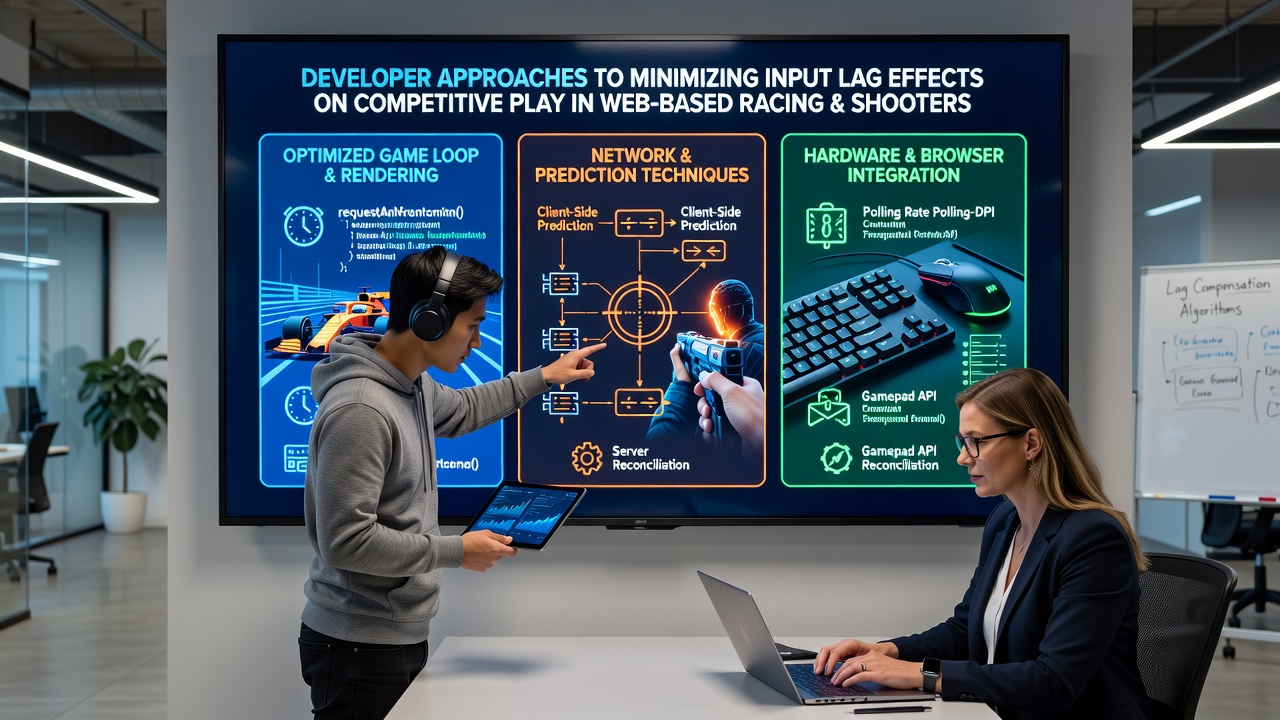
Additional gains come from compressing state updates with binary protocols such as MessagePack over WebSockets, which lowers bandwidth usage and accelerates packet processing on both ends. Developers also tune server tick rates between 60 and 120 Hz, balancing accuracy against hosting costs while providing enough resolution for competitive integrity in fast-paced scenarios.
Measurement and Iterative Refinement Practices
Studios routinely deploy built-in telemetry that logs input timestamps alongside frame delivery data, allowing engineers to identify bottlenecks across different browser versions and operating systems. These datasets inform targeted patches, such as adjusting prediction windows based on detected regional ping averages. Figures from industry monitoring groups reveal that titles employing continuous measurement pipelines achieve more stable competitive environments over multi-month update cycles.
Conclusion
Through layered combinations of prediction, reconciliation, threading optimizations, and precise telemetry, developers continue advancing the responsiveness of web-based racing and shooting competitions. These methods support fairer matches by narrowing the gap between player intent and on-screen action across varied network conditions.